 Albania
 Algeria
 Andorra
 Argentina
 Armenia
 Australia
 Austria
 Azerbaijan
 Bahrain
 Belgium
 Bolivia
 Brazil
 Bulgaria
 Cambodia
 Cameroon
 Canada
 Chad
Chad Chile
Chile China
China Colombia
 Costa Rica
 Croatia
 Cyprus
 Czechia
 Denmark
 Ecuador
 Egypt
Egypt Finland
 France
 Georgia
 Germany
 Ghana
Ghana Greece
 Hungary
 Iceland
 India
India Indonesia
 Ireland
 Italy
Italy Jamaica
 Japan
Japan Jordan
 Kazakhstan
 Kenya
Kenya Kuwait
 Latvia
 Lebanon
 Libya
Libya Lithuania
 Luxembourg
 Malaysia
 Maldives
 Mali
Mali Malta
Malta Mexico
 Moldova
 Monaco
 Morocco
 Netherlands
 New Zealand
 Nigeria
 North Macedonia
 Norway
 Oman
OmanIn Jordan, female engineers lead the way in sustainable agriculture
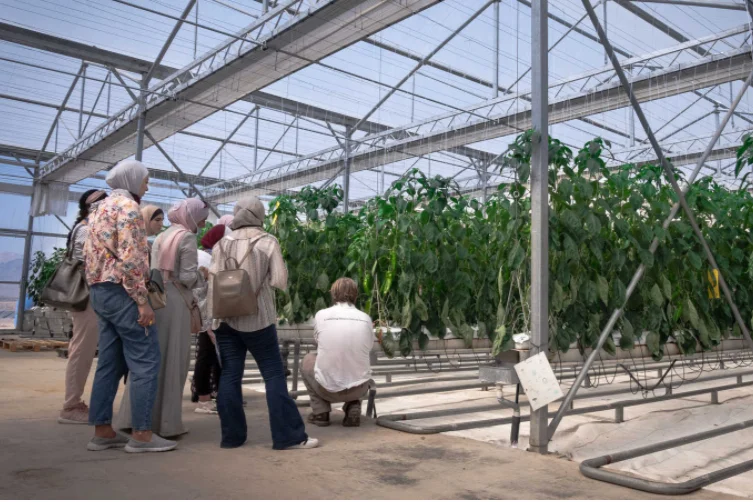
Under the hot Aqaba sun, an all-female team of recent Jordanian university graduates took turns planting lettuce and bok choy seeds in the desert soil. Just minutes earlier, they had prepared a special compost blend — a mix of peat moss and ground coconut shell — which allowed them to turn the otherwise arid soil into fertile ground.
The 15 female engineers were participating in their first site visit of the Sahara Forest Project (SFP) research center in Aqaba, as part of a 12-week training program to boost innovative practices in sustainable agriculture in Jordan. The training program is a joint project between Hussein Technical University and SFP, a Norwegian NGO focused on providing fresh water and food in desert regions.
For many of the participants, this was their first experience seeing what they had learned in university outside of a textbook.
“For me, this was the first time seeing agricultural fields like this,” Dania Shahrori, a 24-year old graduate in water and environmental engineering, told Al-Monitor. “It’s unique to see these new techniques in Jordan,” she said.
The SFP employees guided the participants through the research facility and through the lifecycle of a crop grown using their experimental techniques. The participants first learned how seawater was taken from the Red Sea a few kilometers away and about the desalinization process, before learning how to determine the proper salinity level of the water. They then observed the composting stations outside and the crops grown using the custom-made compost.
The participants asked the two SFP staff members many questions about the research station’s technology, crop yields and the chemistry behind the special compost blends they were making. After stumping the SFP country director with a question about a specific part in the desalinization machine’s reverse osmosis filter, one of the women explained that she was working in a waste management startup and thought the part could be useful for her work.
In Jordan, women make up just 14% of the workforce as of 2019, one of the lowest female labor participation rates in the region. In the agricultural sector specifically, women typically work low-skilled, low-earning jobs, rather than more technical and managerial roles.
To this end, the program not only focused on the technical aspects of sustainable agriculture in Jordan, but also on the soft skills necessary to bring a project to fruition, Ruba al-Zu’bi, a sustainability expert and mentor for the program, told Al-Monitor.